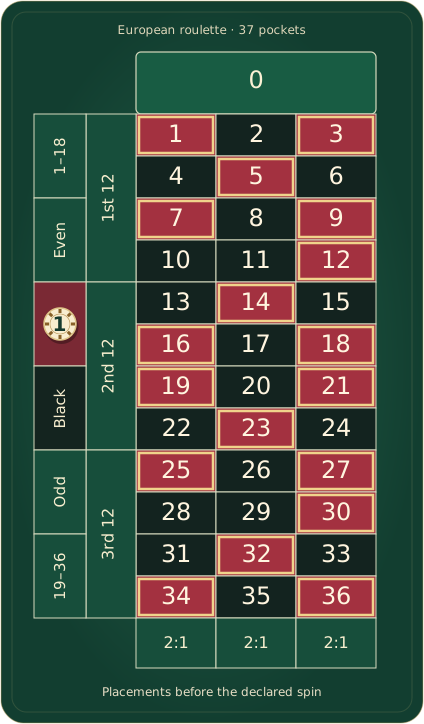
D’Alembert increases an even-money stake by one unit after a loss and decreases it by one after a win, with a one-unit minimum. Stake growth is linear, but a long losing run still creates a rising bill.
Follow the stake as well as the result
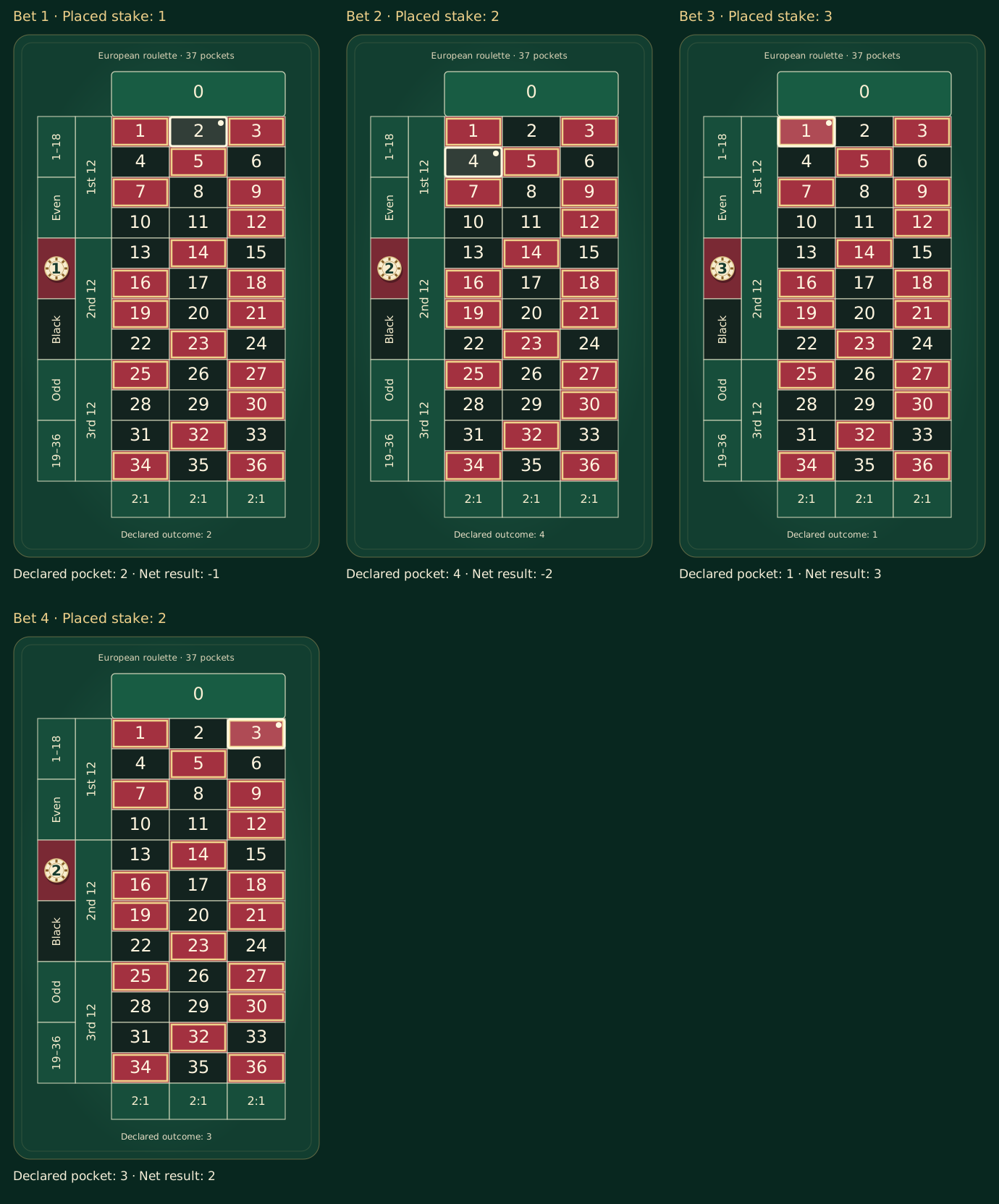
Start with one unit and use the outcomes loss, loss, win, win. The stakes are 1, 2, 3, 2. The cycle earns −1−2+3+2=+2 units. A different order can produce a different result: win, win, loss, loss uses 1, 1, 1, 2 and finishes −1 unit. Both paths contain two wins and two losses. The floor makes the order matter.
Scroll to compare all columns
| After result | Rule for next stake |
|---|---|
| Loss | Add one unit |
| Win | Subtract one, stopping at one |
| No net change | Keep the current stake under this convention |
The audited native named plan follows this one-unit floor. A real demonstration should also stop before a required stake exceeds the wallet or table maximum.
Losing runs are cheaper than doubling, but still grow
Ten consecutive losses at 1 through 10 units consume 55 units. The next stake is 11. Ordinary Martingale loses 1023 units across its first ten failed bets. That comparison describes stake exposure; it does not establish a profitable outcome for D’Alembert. A progression that wagers less also has less money at stake on a later winning spin.
Choose a fair comparison
Compare both systems on the same wheel, outcomes and unit value. Report total wagered beside ending balance. A run that stops at a limit should stay in the results rather than disappear as an unfinished cycle. The strategy simulator gives a bounded comparison; flat betting provides a constant-stake reference.
D’Alembert is often described through balanced win/loss examples. The two paths above show why that description needs its stake rules and order. Read roulette variance for the distinction between changing the shape of results and changing expected return.
Sources and scope
- Rules of Play for Table Games, Roulette. British Columbia Lottery Corporation. Double-zero standard payout table and placement. European pocket count is independently verified from native Wheel.
Publication date: not stated. Checked 2026-11-07.
- Roulette development source. Amenti Labs LLC. Game.swift Wheel, StrategyCatalog, App ProAccess/PurchaseStore/ChipEconomy/Engagement and PrivacyInfo. Source evidence, service behavior not independently retested.
Publication date: 2026-11-07. Checked 2026-11-07.
- Roulette probability derivation. Amenti Labs LLC. Fair independent pockets, fixed payouts, full outside loss on zero. Formula and all supported bets regression tested.
Publication date: 2026-11-07. Checked 2026-11-07.