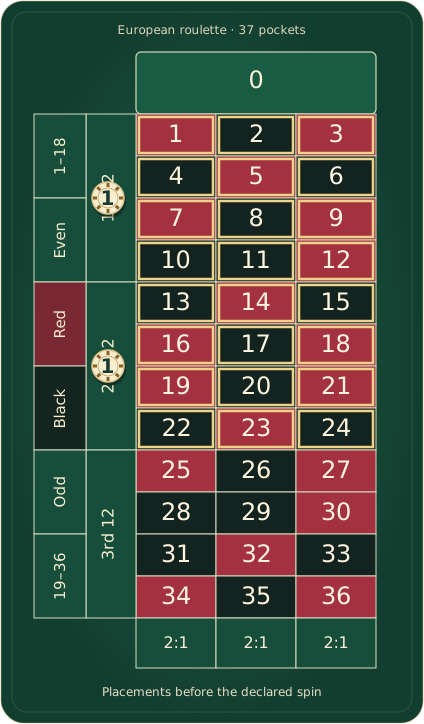
Place one unit on each of two different dozens. This covers 24 numbers with a total stake of two units. A result in either selected dozen earns one unit of net profit; any other result loses two.
Place the example
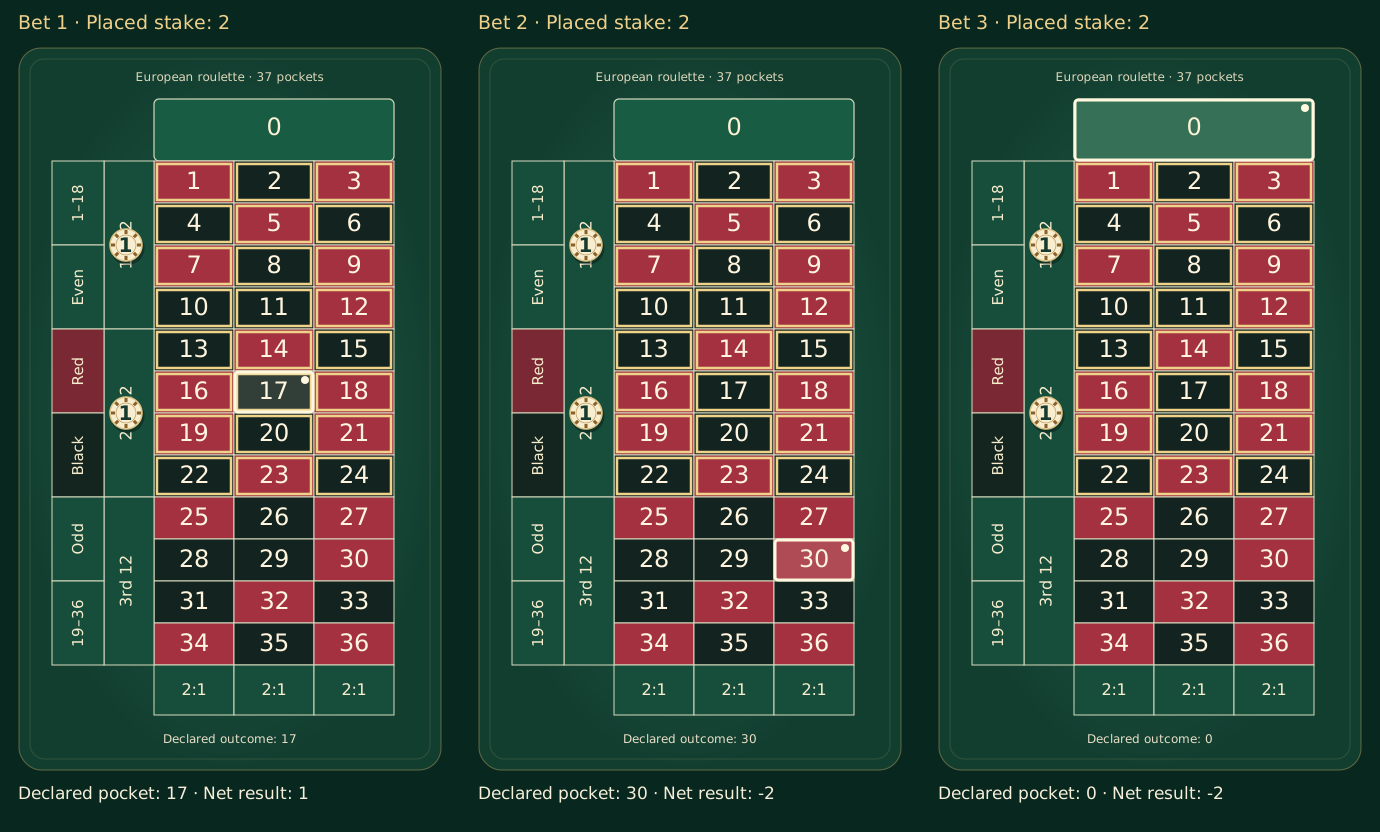
Choose the first dozen 1–12 and second dozen 13–24. If 17 lands, the second-dozen wager returns three units: two units of profit plus its original unit. The first-dozen wager loses. Three returned minus two staked leaves one unit overall.
If 30 lands, neither wager pays and the net loss is two. Zero also loses both wagers under the ordinary rules used here. On an American wheel, 00 adds another losing pocket.
Scroll to compare all columns
| Wheel | Net+1 pockets | Net−2 pockets | Expected net per spin |
|---|---|---|---|
| European | 24 | 13 | −2/37 units |
| American | 24 | 14 | −4/38 units |
Dividing the expected loss by the two-unit stake gives the ordinary wheel edge:1/37 for European and 2/38 for American. Covering two thirds of the numbered table does not remove the zeros.
What happens after a loss?
The layout alone does not specify a progression. Keeping both wagers at one unit is a flat two-dozen layout. Doubling them after a loss adds a separate staking rule and doubles the total layout cost. Some named systems also switch which dozen they leave uncovered. That switch changes the selected numbers, not the probability of the next fair spin.
With ten practice units, five consecutive full misses exhaust the wallet at flat stakes. A simulation should state whether it stops there or earlier at a preset loss limit.
The audited native preset called Two dozens uses the first and second dozens at equal stakes. Compare two columns for the same arithmetic on different pockets, or inspect coverage bets before combining this with other wagers.
Sources and scope
- Rules of Play for Table Games, Roulette. British Columbia Lottery Corporation. Double-zero standard payout table and placement. European pocket count is independently verified from native Wheel.
Publication date: not stated. Checked 2026-11-07.
- Roulette development source. Amenti Labs LLC. Game.swift Wheel, StrategyCatalog, App ProAccess/PurchaseStore/ChipEconomy/Engagement and PrivacyInfo. Source evidence, service behavior not independently retested.
Publication date: 2026-11-07. Checked 2026-11-07.
- Roulette probability derivation. Amenti Labs LLC. Fair independent pockets, fixed payouts, full outside loss on zero. Formula and all supported bets regression tested.
Publication date: 2026-11-07. Checked 2026-11-07.