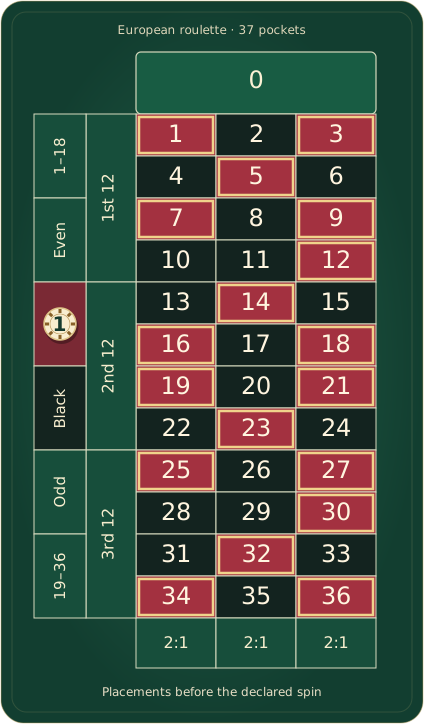
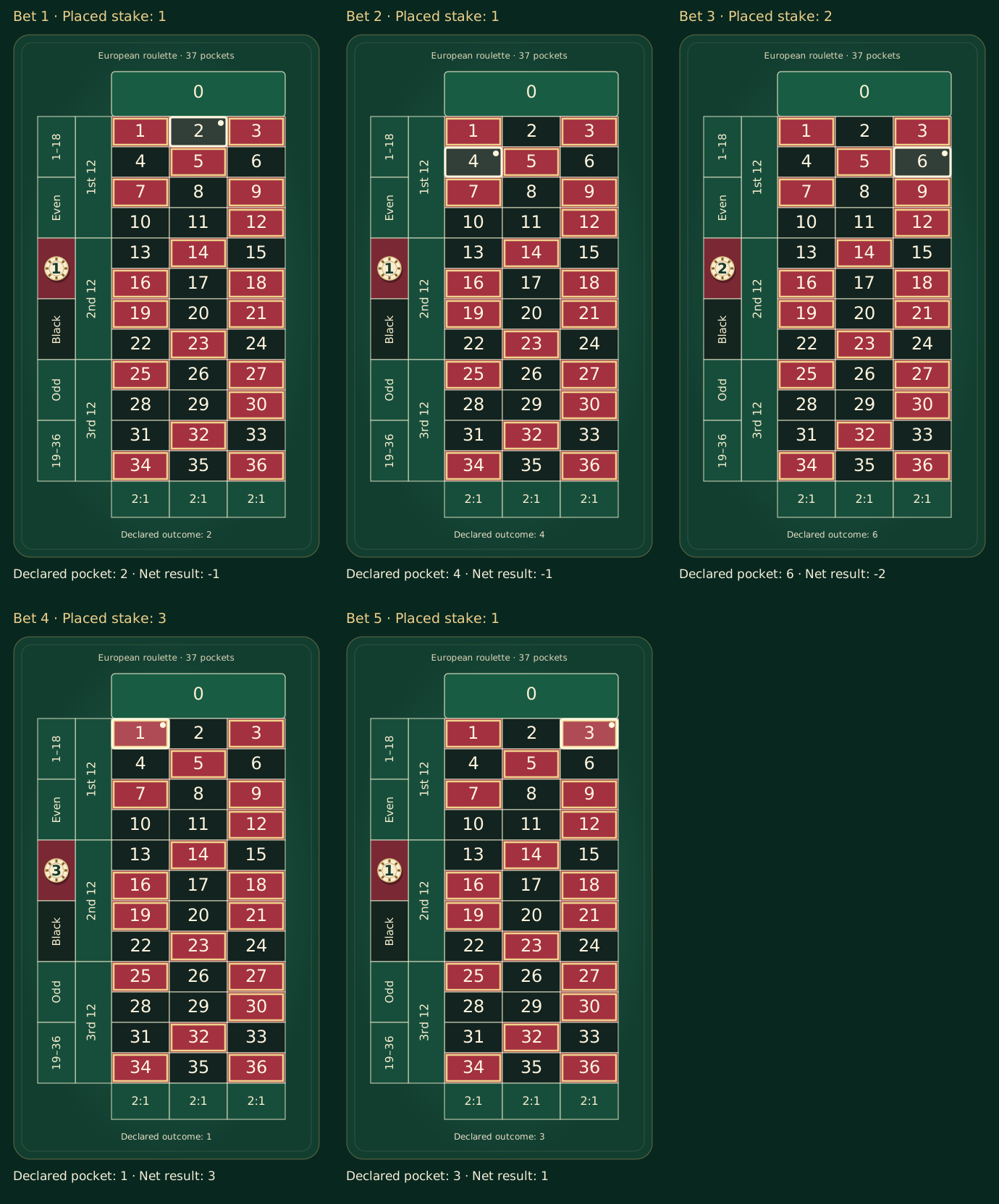
The named Fibonacci plan uses stakes 1, 1, 2, 3, 5, 8, 13 and onward. A loss moves one position forward; a win moves two positions back, stopping at the first position. Tracking the position matters because the opening 1 appears twice.
A path with a partial recovery
Start at position zero. Loss, loss, loss, win gives stakes 1, 1, 2, 3 and net −1−1−2+3=−1. After the win, the position moves from 3 back to 1, so the next stake is 1. A further win produces a level balance and returns the position to zero. One win does not necessarily recover every preceding loss.
Scroll to compare all columns
| Position | 0 | 1 | 2 | 3 | 4 | 5 | 6 | 7 |
|---|---|---|---|---|---|---|---|---|
| Units | 1 | 1 | 2 | 3 | 5 | 8 | 13 | 21 |
The budget ends the sequence
The first eight losing bets cost 54 units. With a 100-unit budget, the next 34-unit bet is affordable, leaving 12 after another loss. The following 55-unit stake is unaffordable. A slower increase than doubling still creates a finite stopping point.
A table maximum creates another limit even when enough chips remain in the wallet. The demonstration must stop before the invalid bet; it should not silently reduce the wager or assume a credit line. Those changes create a different system.
Two app presets with different rules
The audited development source contains the named Fibonacci staking plan and an older template called Fibonacci steps. The older template has eight capped multipliers and retreats one position after a win. The named plan advances one after a loss and retreats two after a win, with a separate internal position limit. Our worked example follows the named plan.
Use bankroll and table limits to interpret an early stop. Compare Martingale and D’Alembert by total wagered and maximum stake, then inspect a fixed example in the strategy simulator.
Sources and scope
- Rules of Play for Table Games, Roulette. British Columbia Lottery Corporation. Double-zero standard payout table and placement. European pocket count is independently verified from native Wheel.
Publication date: not stated. Checked 2026-11-07.
- Roulette development source. Amenti Labs LLC. Game.swift Wheel, StrategyCatalog, App ProAccess/PurchaseStore/ChipEconomy/Engagement and PrivacyInfo. Source evidence, service behavior not independently retested.
Publication date: 2026-11-07. Checked 2026-11-07.
- Roulette probability derivation. Amenti Labs LLC. Fair independent pockets, fixed payouts, full outside loss on zero. Formula and all supported bets regression tested.
Publication date: 2026-11-07. Checked 2026-11-07.