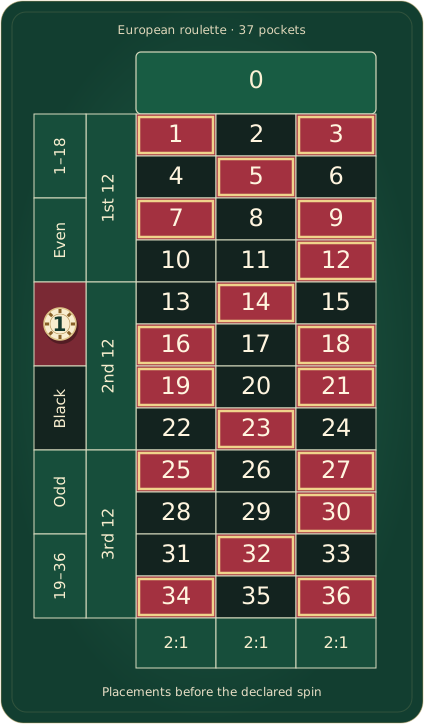
Reverse D’Alembert adds one unit after a win and subtracts one after a loss, with a one-unit floor. It directs larger stakes toward winning runs. A reversal can give back earlier gains.
The same outcomes, a different stake path
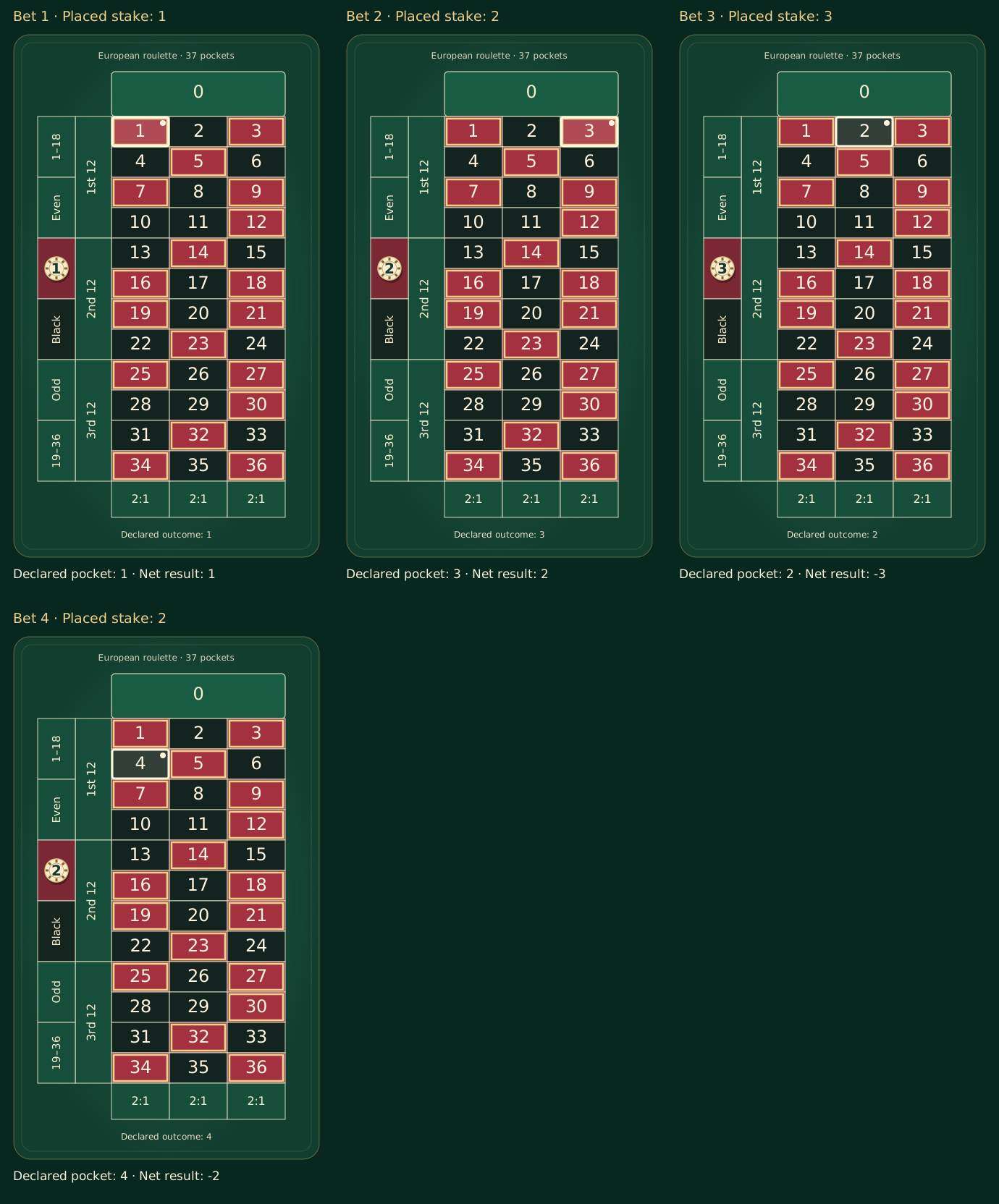
Take win, win, loss, loss, with a starting stake of one. Reverse D’Alembert wagers 1, 2, 3, 2 and returns +1+2−3−2=−2 units. Ordinary D’Alembert wagers 1, 1, 1, 2 on that same path and finishes −1. A count of winning spins alone cannot tell us which balance is higher.
Change the order to loss, loss, win, win. Reverse D’Alembert wagers 1, 1, 1, 2 and finishes +1 unit. Ordinary D’Alembert uses 1, 2, 3, 2 and finishes +2. These are complete four-spin examples, not estimated success rates.
A floor and a ceiling serve different purposes
The one-unit floor keeps the stake positive. It does not bound the top of the progression. After ten consecutive wins the next stake is 11 units. A chosen table maximum or session budget must still limit the run. The audited native plan uses the add-on-win, subtract-on-loss rule; naming another convention requires stating its actual transitions.
Read the exposure
Reverse D’Alembert changes stakes by one unit, while Paroli doubles after wins and ends its capped cycle. Those rules should not be treated as interchangeable simply because both raise after wins. Compare the stake path, reset condition and maximum possible next bet.
Use a matched strategy simulation to hold outcomes fixed. Keep track of each spin's wager, net settlement and ending balance. The fair-wheel probability of a red result remains 18/37 on a single-zero wheel regardless of the previous sequence. Our probability guide explains that assumption.
Sources and scope
- Rules of Play for Table Games, Roulette. British Columbia Lottery Corporation. Double-zero standard payout table and placement. European pocket count is independently verified from native Wheel.
Publication date: not stated. Checked 2026-11-07.
- Roulette development source. Amenti Labs LLC. Game.swift Wheel, StrategyCatalog, App ProAccess/PurchaseStore/ChipEconomy/Engagement and PrivacyInfo. Source evidence, service behavior not independently retested.
Publication date: 2026-11-07. Checked 2026-11-07.
- Roulette probability derivation. Amenti Labs LLC. Fair independent pockets, fixed payouts, full outside loss on zero. Formula and all supported bets regression tested.
Publication date: 2026-11-07. Checked 2026-11-07.